Microsoft 365 Copilot rollout
Licensing and readiness review, permission and oversharing clean-up before switch-on, pilot group design, adoption training and usage reporting — so the licences you pay for get used.
Assistants that answer questions are table stakes. The work now is agents that take actions — reading your systems, drafting the response, filing the record and stopping for a human at the point where judgement is needed.
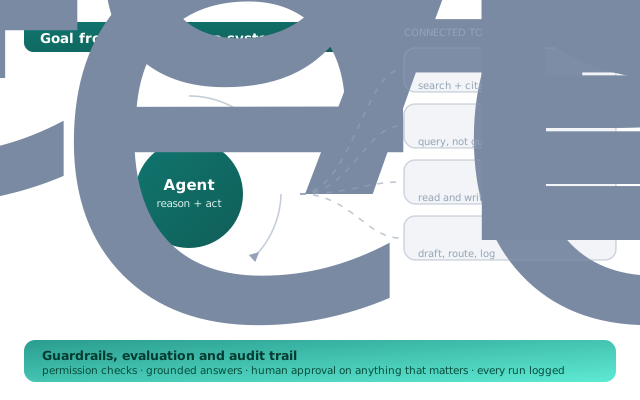
This is the next step on from the retrieval assistants on our AI & Machine Learning page. The difference is that an agent does not just retrieve and reply — it is given tools, a goal and a boundary, and it works until the job is done or it needs a person.
Licensing and readiness review, permission and oversharing clean-up before switch-on, pilot group design, adoption training and usage reporting — so the licences you pay for get used.
Agents grounded on your own content and systems, built with Copilot Studio, Azure AI Foundry or a framework of your choosing, with answers that cite where they came from.
Giving an agent safe, scoped access to the systems it needs, through function calling and the Model Context Protocol, so it queries the database rather than guessing at the answer.
Longer running work handed to an agent: triage an inbox, reconcile two systems, prepare a quote, chase an exception — with a checkpoint wherever a person should confirm before anything is committed.
A test set built from real cases, scored on every change; content filters, permission checks that respect the user’s own access, spend limits, and a full log of what the agent did and why.
An acceptable-use policy people can actually follow, a register of what is deployed and on what data, and controls mapped to the NIST AI Risk Management Framework and to your own obligations.
Agents earn their keep on the tasks that are repetitive, rule-heavy and currently done by someone reading one screen and typing into another. They are a poor fit for anything that needs accountability without a human in the loop.
We pick a single workflow with a countable volume and a clear definition of done. That gives an honest before-and-after number instead of an impression.
Accuracy, escalation rate, handling time and cost per run are tracked from the first week. An agent that cannot beat the current process is stopped, not expanded.
Anything that spends money, contacts a customer or changes a record of account waits for approval. Autonomy is earned per action, once the evidence supports it.
A short workshop to find the processes worth automating, sized by volume, cost and how tolerant each one is of an occasional wrong answer.
A working agent on real data within a few weeks, scored against a test set drawn from your own past cases rather than a demo script.
Permissions, guardrails, logging, cost controls and fallbacks. This is the part that separates a pilot from something you can put in front of customers.
Monitoring for drift and cost, a regular review of escalations, and retraining or reprompting as your processes and your models move on.
Microsoft 365 Copilot, Copilot Studio, Azure AI Foundry, Azure OpenAI, Azure AI Search and Entra ID for the permission model.
The Model Context Protocol for tool access, LangChain and LangGraph, Semantic Kernel, and evaluation harnesses that run in your pipeline.
Amazon Bedrock and Google Vertex AI where the rest of the estate already lives, and open models where data residency or cost makes that the better answer.
We will tell you honestly whether an agent is the right answer for it, what it would take to prove, and what it would cost to run. Sometimes the answer is a script and a form.