Cloud strategy & landing zones
Target operating model, subscription and account structure, network topology, identity, policy guardrails and baseline security — the foundation that keeps a growing estate from turning into sprawl.
Strategy, landing zones, migration, modernisation and managed operations across Microsoft Azure, Amazon Web Services and Google Cloud — built so that the platform stays secure, observable and affordable long after the migration project closes.
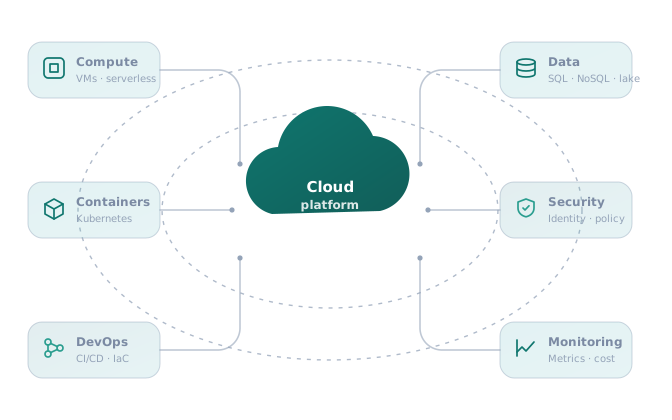
Cloud computing provides a highly elastic environment that delivers on-demand infrastructure over the internet — networks, servers, storage, applications and services that can be deployed quickly, with cost efficiency and minimal management effort. Getting that promise in practice takes deliberate engineering.
Target operating model, subscription and account structure, network topology, identity, policy guardrails and baseline security — the foundation that keeps a growing estate from turning into sprawl.
Application and data migration using IaaS, PaaS and SaaS models — rehost where speed matters, refactor where the running cost or agility justifies it, and retire what nobody uses.
Container platforms on AKS, EKS or GKE with ingress, autoscaling, secrets management, image scanning and progressive delivery — plus the runbooks your team needs to operate them.
Infrastructure as code with Terraform or Bicep, CI/CD pipelines, environment promotion, automated testing gates and repeatable provisioning — so releases are routine rather than events.
Identity and access design, network segmentation, key and secret management, encryption, posture management and audit logging — aligned to the controls your customers and regulators expect.
Tagging and showback, rightsizing, commitment planning, storage lifecycle policies and anomaly alerts — turning an unpredictable monthly bill into a number your finance team can forecast.
Cost is a major driver, but so are agility, flexibility and the speed at which new applications can be deployed. That shift changes application development priorities — and it rewards teams who build the platform properly the first time.
App Service, Azure Functions, AKS, Azure SQL, Data Factory, Synapse, Entra ID, Bicep and Azure DevOps — a natural fit for the .NET and SQL Server estates we have supported since 2014.
EC2, ECS and EKS, Lambda, RDS and Aurora, S3, Glue, Step Functions, IAM and CloudFormation or Terraform for repeatable infrastructure.
GKE, Cloud Run, BigQuery, Pub/Sub, Dataflow and Vertex AI — particularly where analytics and machine learning workloads lead the architecture.
Not everything belongs in a public region. We design hybrid estates where data residency, latency or existing investment makes that the right answer.
Portable patterns based on containers, open standards and infrastructure as code, so a second provider is a decision rather than a rewrite.
24×7 monitoring, patching, incident response and capacity planning, with locally available managers who work closely with our clients in the USA.
Recovery objectives agreed with the business, implemented with replication and backup, and proven with regular restore tests.
Our cloud assessment services are designed to weigh cloud benefits against your organisation’s actual requirements, so the transition happens in a quick and methodical way.