BONITSThink · Do · Achieve
Services

Artificial Intelligence & Machine Learning

We help organisations move from AI experiments to working systems — assistants grounded in your own content, models that forecast and classify, and the engineering discipline that keeps them accurate, governed and affordable in production.

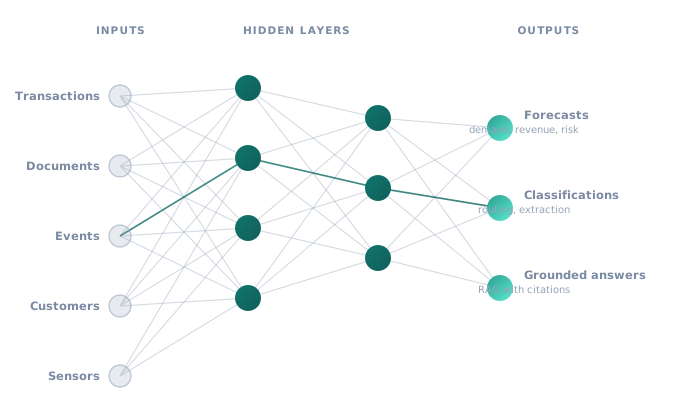
A neural network diagram: inputs such as transactions, documents and events feed hidden layers that produce forecasts, classifications and grounded answers.
What the models actually do: turn the data you already hold into forecasts, classifications and answers you can cite.
Where we help

AI capabilities we design, build and operate

Every engagement starts with a business question rather than a model. We look for the decisions and workflows where prediction or language understanding changes the outcome — and we are equally willing to tell you when a simpler rule or a better report would do the job.

Generative AI & RAG assistants

Assistants and search experiences grounded in your own documents, tickets, policies and product data using retrieval-augmented generation — with citations, access control that respects existing permissions, and guardrails against unsupported answers.

Forecasting & predictive models

Demand, revenue, churn, capacity and risk models built on your historical data, validated against real hold-out periods, and delivered with the confidence intervals that make them safe to plan against.

Document & content intelligence

Extraction, classification and summarisation for invoices, contracts, forms and correspondence — turning unstructured paperwork into structured records your existing systems can process.

Computer vision

Image and video models for quality inspection, safety monitoring, counting and condition assessment — deployed to the cloud or to edge devices where latency and connectivity demand it.

MLOps & platform engineering

Feature pipelines, model registries, automated evaluation, CI/CD for models, drift and cost monitoring, and rollback paths — so a model that works in a notebook keeps working a year after launch.

Responsible & governed AI

Data lineage, PII handling, evaluation sets, human-in-the-loop review, audit logging and clear model documentation — the controls your risk, legal and compliance colleagues will ask for.
How an engagement runs

From use case to production, without the science project

Most AI programmes stall between the demo and the deployment. Our delivery model is built to cross that gap: we prove value on a narrow, measurable use case, then invest in the platform only once the value is real.

  • Discovery & use-case shaping — we map candidate use cases against data readiness, business value and risk, and pick the one that can show a result fastest.
  • Data readiness assessment — what you have, where it lives, how clean it is, and what has to be fixed before a model can learn anything useful from it.
  • Proof of value — a working prototype against real data with an agreed success metric, not a slide deck.
  • Productionisation — the model wrapped in APIs, pipelines, monitoring, security and cost controls, integrated with the systems your people already use.
  • Operate & improve — ongoing evaluation, retraining as data shifts, and cost tuning as usage grows.
1. Data sources Apps, warehouse, documents 2. Feature pipeline Clean, join, label, version 3. Train & evaluate Baselines, hold-out, metrics 4. Serve APIs, batch, streaming 5. Monitor & govern Drift, quality, cost, audit trail retrain
Toolchain

The stack we work in

We stay deliberately portable. Where a managed cloud service is the pragmatic answer we will use it; where lock-in would cost you later, we build on open frameworks that run anywhere.

Models & frameworks

  • Python
  • PyTorch
  • scikit-learn
  • XGBoost
  • Hugging Face
  • LangChain
  • OpenCV
  • ONNX

Platforms & services

  • Azure AI & Machine Learning
  • Amazon SageMaker & Bedrock
  • Google Vertex AI
  • Databricks
  • Kubernetes
  • MLflow
  • Vector databases
Typical engagement shapes
EngagementTypical durationWhat you get
AI readiness assessment2–4 weeksPrioritised use-case backlog, data gap analysis, target architecture and a costed roadmap.
Proof of value4–8 weeksWorking prototype on your data, measured against an agreed success metric, with a go / no-go recommendation.
Production build3–6 monthsDeployed service, pipelines, monitoring, documentation and handover or managed operation.
Managed AI operationsOngoingEvaluation, retraining, incident response, cost optimisation and quarterly improvement planning.

Durations are indicative starting points and are confirmed after discovery — they vary with data readiness, integration surface and compliance requirements.

Our position

Useful AI is mostly good engineering

The hard part of an AI project is rarely the model. It is the data you can trust, the integration into a real workflow, and the operational discipline to keep it honest once it is live.

That is the same engineering rigour BONITS has applied to application development, data warehousing and testing since 2014 — now pointed at a new class of problem.