Infrastructure & Operations
Where infrastructure is actually heading: deliberate workload placement instead of cloud-first, fabrics that carry AI traffic, security enforced at the workload, and operations that are increasingly run by software rather than by people watching dashboards.
This page is a map of the ground rather than a price list. Some of what follows we run for clients today, some we are building towards, and some is on the horizon and worth planning for now because the decisions you make this year will make it easy or expensive later. Where a line here is already a service, it links to that page.
Infrastructure, on-premise and hybrid multi-cloud
The pendulum has stopped at neither end. The question is no longer whether to be in the cloud but which workload belongs where, and whether you can move it once you have decided.
- Hybrid-by-design architectures — workloads placed deliberately across on-premise, private cloud, public cloud and edge on the basis of cost, compliance and performance, rather than a blanket cloud-first rule applied to everything.
- Multi-cloud data synchronisation — stateful applications distributed across more than one provider so that a single cloud failure degrades service rather than stopping the business.
- The great replatforming — the move off expensive legacy virtualisation towards open-source hypervisors, container platforms and cloud-native infrastructure, driven by licensing costs and a wish for vendor independence.
- AI-optimised hardware stacks — dedicated GPU clusters and specialised compute for training and inference, where the choice between hyperscale, private and edge has become a board-level decision rather than an infrastructure one.
- Edge computing nodes — compute placed close to where the data is produced, on factory floors, in stores and in vehicles, to cut latency and the bandwidth bill for real-time work.
Networking
AI traffic broke the assumptions the enterprise network was built on. East-west volume between accelerators looks nothing like the north-south traffic that switch was sized for.
- Unified network fabrics — a single architecture carrying high-performance AI and machine learning traffic alongside ordinary enterprise workloads, using liquid-cooled silicon and 1.6T optics to do it.
- Network observability platforms — visibility that runs from the fabric down to the individual accelerator, so an AI job can be monitored and tuned rather than guessed at.
- Agentic NetOps — AI-driven automation of configuration, fault detection and self-healing in the network, which most analysts expect to be mainstream within two to five years.
- Zero-trust network access — identity and context checked on every request, replacing the flat network access a traditional VPN grants once someone is inside.
- In-fabric security enforcement — policy pushed into the switch so micro-segmentation happens at the top of each rack, instead of hair-pinning distributed traffic through a central firewall.
- SD-WAN with integrated SASE — software-defined wide-area networking and secure access service edge delivered together, so branch offices and remote users get one connectivity and security model.
Security
The perimeter stopped being a useful idea some time ago. What replaces it is control at the workload, enforced automatically and assumed to be breached.
- Micro-segmentation — fine-grained controls between servers and applications that restrict lateral movement and limit the blast radius of a breach. Forecast to grow at around twenty-one percent a year through 2030.
- Workload-following security policy — tags and rules that migrate with a Kubernetes pod or a virtual machine, so enforcement survives the workload being moved.
- In-fabric threat remediation — compensating controls applied directly at the switch to close an exposure window immediately, rather than waiting for the next patching window.
- AI-assisted detection and response — extended detection and response platforms correlating signals across endpoints, network and cloud so an incident is identified in minutes rather than weeks.
- Post-quantum cryptography readiness — an inventory of what uses which algorithm and a migration path to quantum-resistant ones, because data captured today can be decrypted later.
- Identity-first security with zero standing privileges — permission granted for the duration of a task and withdrawn afterwards, instead of always-on privileged accounts waiting to be stolen.
AI, machine learning and AIOps
Two directions at once: using AI to run infrastructure, and building infrastructure fit to run AI. The second is what makes the first affordable.
- AIOps platforms — alert noise reduced, events correlated across the stack, root-cause analysis accelerated and low-risk remediation carried out without waking anyone.
- Agentic AI for infrastructure automation — autonomous agents handling network management, cloud cost optimisation and endpoint lifecycle work, within boundaries a person sets.
- Predictive capacity planning — models reading historical telemetry to forecast what will be needed, so scaling happens ahead of degradation rather than after the complaint.
- Intelligent workload placement — engines that choose between on-premise, one cloud, another cloud or the edge against live cost, performance and compliance policy.
- Augmented FinOps — continuous analysis of infrastructure spend with automated rightsizing and enforced budget guardrails, aimed squarely at spiralling GPU and cloud bills.
- AI observability and model monitoring — production tracking of model accuracy, drift and fairness, so a model that has quietly stopped working is noticed.
Kubernetes and containers
Kubernetes has quietly become the place AI workloads are scheduled, which has pulled a set of older ideas back into the mainstream and given them a new job.
- Kubernetes as the AI control plane — orchestrating AI and machine learning workloads, scheduling GPU resources and coordinating agent-based applications. Around two thirds of organisations now use it for this.
- Gateway API for ingress — the more expressive successor to Ingress controllers, with clearer separation between platform and application roles and more flexible routing.
- Service mesh, revived — Istio and Linkerd back in favour for east-west traffic management, API governance and observability of non-deterministic agent-to-agent communication.
- Kubernetes and network fabric integration — clusters bridged to the physical fabric beneath them, giving one operational model for visibility, policy and security across both layers.
- Policy as code — Open Policy Agent and Gatekeeper enforcing security and compliance rules inside the cluster, so a non-compliant configuration is refused rather than found in an audit.
- GitOps for infrastructure — declarative, version-controlled configuration with Argo CD or Flux, where a rollout and a rollback are the same operation in reverse.
Operations and governance
The disciplines that decide whether any of the above is affordable, survivable and defensible a year after it is built.
- FinOps as a core discipline — cost work extended past the cloud bill to GPU reservations, data egress and the unit economics of what you actually sell.
- Platform engineering and internal developer platforms — curated self-service environments, often built on Backstage, that hide infrastructure complexity while enforcing security and cost guardrails.
- Resilience engineering — designing deliberately for graceful degradation and fast recovery, including chaos practices that test failure modes before those modes find you.
- Geopatriation and technology sovereignty — workloads moved from global hyperscale providers to regional or national ones in response to data residency law and geopolitical risk.
- Green IT and carbon-aware computing — energy use measured, and work scheduled against renewable availability and carbon intensity rather than run flat out regardless.
- Observability 3.0 — metrics, logs and traces joined by continuous profiling and incident context, so the question moves from what broke to why it broke.
Nobody adopts thirty-five things
Read this as a checklist for a conversation, not a shopping list. Most organisations have two or three of these that are urgent and thirty that are not, and the value is in telling them apart before a budget is committed.
- Start where the pain is measurable — a cloud bill growing faster than revenue, an outage that could not be explained, an audit that will arrive whether you are ready or not.
- Prefer the reversible decision — containers, infrastructure as code and open standards keep a placement choice revisable. That option has a price and it is usually worth paying.
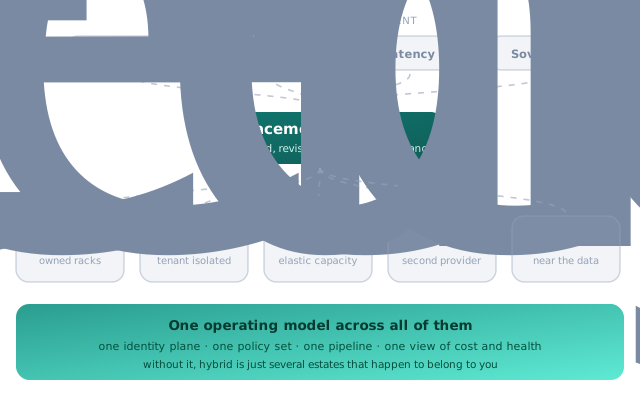
- Buy the operating model, not the product — one identity plane, one policy set, one pipeline and one view of cost matter more than which vendor sits underneath them.
- Plan the long-lead items early — cryptography migration and sovereignty moves take years, so the work begins well before the deadline is visible.
Where we are strongest
Hybrid placement, Kubernetes platforms, infrastructure as code, GitOps, observability and FinOps. This is the work our cloud and managed services teams do week to week.
Where we partner
Network fabric hardware, penetration testing and formal certification assessment come from accredited specialists, coordinated by us rather than resold blind.
Where we advise first
Post-quantum readiness, sovereignty and carbon-aware scheduling usually start as an assessment, because the right answer depends on obligations that are specific to you.
Which two of these actually matter to you?
Bring us your estate and the thing about it that worries you most. We will tell you which of the above is urgent, which is worth planning for, and which you can safely ignore for another two years.